Regarding the Duck Incident
After my last post briefly mentioned the duck incident, many of you asked me to explain what actually happened, which is fair, because “duck incident” is not the kind of phrase a responsible organization should leave unexplained.
First, for the record, the duck incident was technically not my fault.
That sentence appeared no fewer than eleven times in the final report, which I feel shows admirable consistency under pressure.
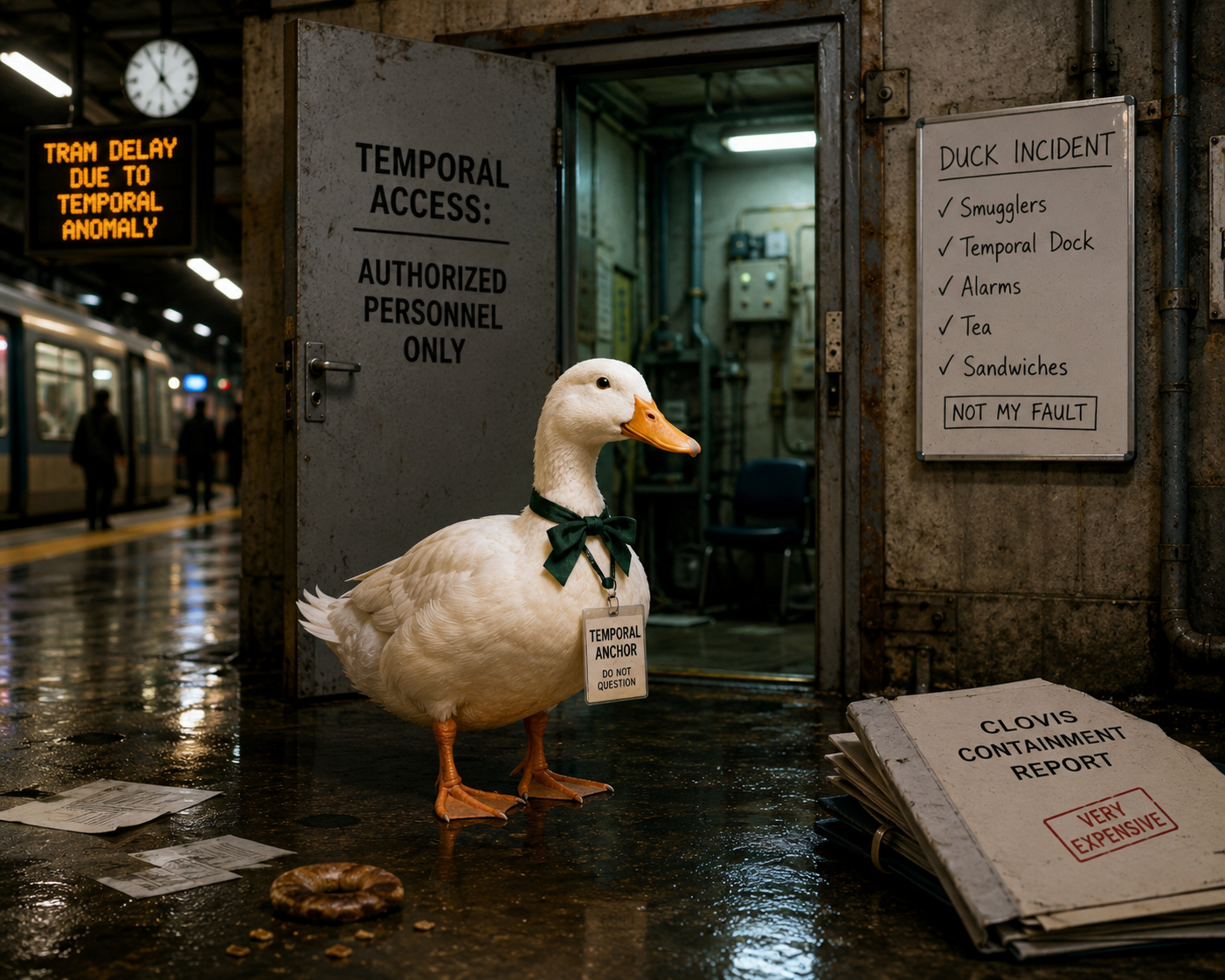
It started on a rainy Thursday in Seeburg, near the old tram platforms behind the eastern market district. I had only gone there because Clovis procurement insisted that the transfer forms for a dimensional refrigeration unit required an in-person signature due to “cross-reality customs harmonization.”
Which already sounded suspicious.
The courier never arrived.
Instead, I found a duck.
At first glance, it was not an unusual duck. White feathers. A green ribbon around its neck. Standing very calmly in the middle of the platform while commuters walked around it as if this was perfectly normal civic behavior.
The problem began when the duck looked directly at me and said:
“You’re late.”
Not loudly. Not with any magical echo. Just disappointed.
I stared at it for several seconds before asking the only reasonable question.
“Can ducks normally talk in this district?”
An old woman nearby shrugged and said, “Only on Thursdays.”
Which, unfortunately, did not help narrow things down.
The duck then waddled toward a maintenance door marked TEMPORAL ACCESS: AUTHORIZED PERSONNEL ONLY and somehow opened it with its beak.
Now, Clovis training explicitly states:
“Do not follow mysterious animals into restricted temporal infrastructure.”
But Clovis training also assumes that you have slept more than four hours and have not spent the morning arguing with accounting over reimbursement receipts for walnut cake.
So I followed the duck.
Inside was an unauthorized temporal docking bay.
A small one. Barely larger than a garage. Illegal portable anchor equipment everywhere. Half the room smelled of ozone and wet feathers.
It turned out the duck was being used by smugglers.
Not metaphorically.
The duck itself was the anchor.
Some species from a flooded parallel reality naturally stabilize micro-temporal corridors. Extremely rare. Extremely illegal to transport without permits. Apparently, the smugglers had disguised it as an ordinary park duck because nobody questions ducks.
Honestly, brilliant strategy.
Unfortunately, the duck had become emotionally attached to the tram station bakery lady and refused to leave Seeburg.
This escalated quickly.
One smuggler arrived through the docking gate yelling, “Grab the bird!”
The duck hissed at him.
Not a normal hiss.
Every clock in the docking bay stopped simultaneously.
Another man slipped on the wet floor tiles, crashed into a crate of imported tea, and accidentally activated an emergency evacuation beacon.
Somewhere above us, alarms started screaming in three languages and one form of communication I can only describe as aggressively geometric.
The duck calmly walked behind me like I was its lawyer.
By the time Clovis containment arrived, the smugglers had temporal frostbite, the docking equipment had fused into the ceiling, and the duck was eating somebody’s sandwich.
The expense report afterward was magnificent.
* Damaged coat.
* Three broken synchronization anchors.
* Emergency tram stoppage fee.
* Tea contamination compensation.
* Bakery reimbursement.
* One veterinary consultation.
* Six walnut cakes.
* Duck-related operational losses.
And at the bottom, handwritten by procurement:
“Next time, please file fauna incidents under the correct departmental category.”
The duck was eventually relocated to a protected pond somewhere outside normal spacetime.
Although every few months, I still receive unsigned postcards containing only one word:
“Quack.”
Clovis still has not determined whether this constitutes a security threat.